
A fidget does not need to be complicated to earn a spot on your desk or keyring. The right one gives your hands a small, satisfying thing to do while you wait, think, listen, or take a quick break. 3D printed fidgets make that simple idea more personal. They can click, bend, twist, roll, or pose. They can look like a tiny snack, a sports ball, a creature, or a little object that makes you laugh every time you pick it up.
That variety is the point. There is no single best fidget for everyone, because the experience lives in the details: how much movement you want, whether sound is welcome, how much space you have, and whether you want a useful keychain or a tiny desk companion. This guide walks through the most common kinds of 3D printed fidgets and the questions that make choosing one much easier.
What are 3D printed fidgets?
3D printed fidgets are small, tactile objects made layer by layer from durable filament. Some have a single moving part, like a pressable button. Others use connected segments that swing, flex, or fold. The printing process makes it possible to create shapes that are difficult to mold in one piece, including linked chains, articulated creatures, nested forms, and tiny mechanisms with a lot of personality.
They are often called desk toys, pocket fidgets, or keychain fidgets because they are designed for short moments of interaction. You might keep one by a keyboard, pick one up during a phone call, or clip a compact one to a bag. The useful part is not a rule about how to use it. It is simply having a small object that feels good to handle.
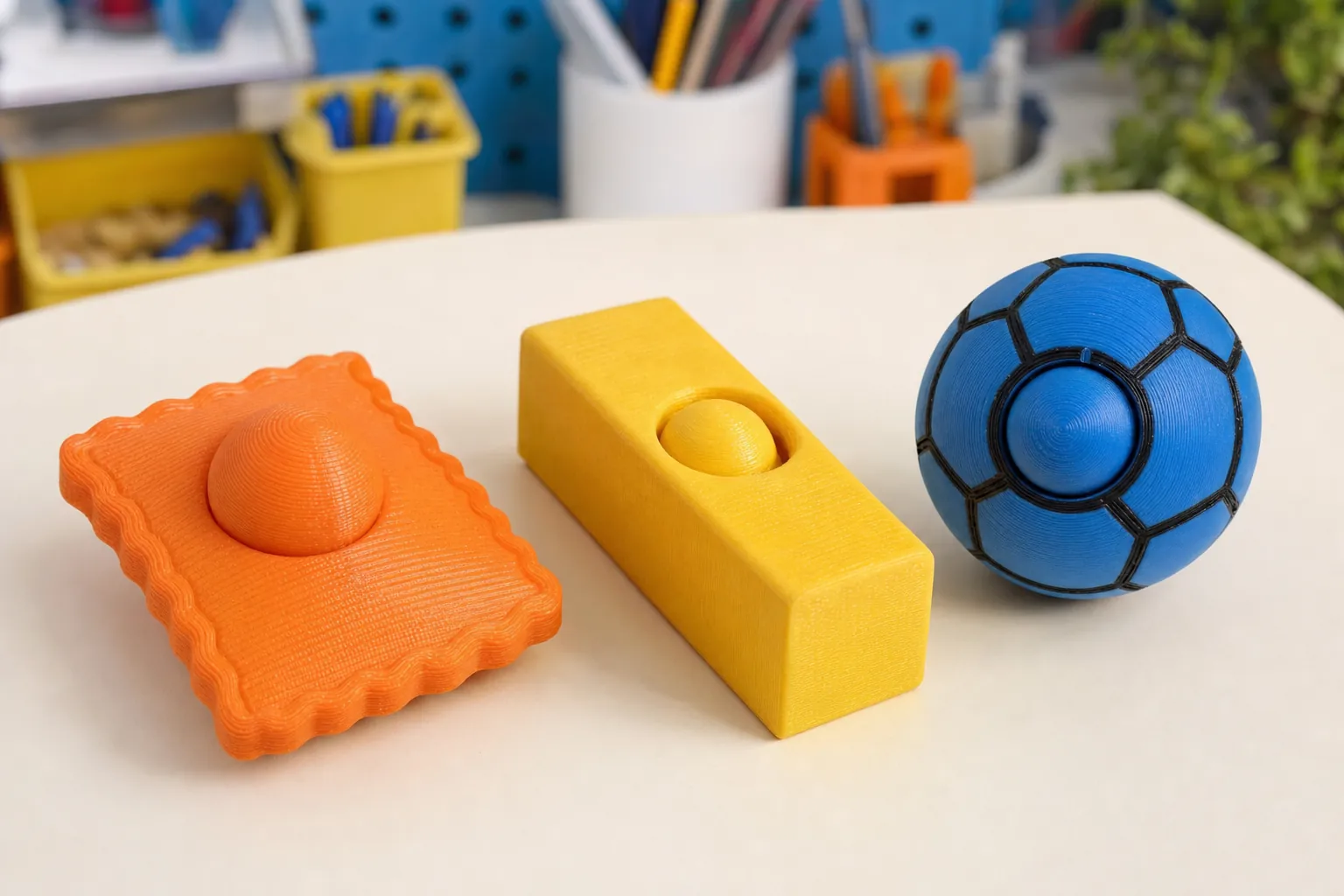
One visual difference is the fine texture left by the printer. Those faint lines are normal on a made-to-order piece. They create a grippy surface, catch the light in a fun way, and make the object feel less like it came from a factory shelf. If you enjoy handmade details, they are part of the appeal.

Start with the kind of movement you enjoy
Before choosing a shape, choose a motion. A fidget only becomes a favorite when the action feels natural enough that you reach for it without thinking. The simplest way to narrow the field is to decide whether you prefer pressing, flexing, rolling, or posing.
- Pressing: Clickers and button-style fidgets give your thumb or finger one repeatable action. They work well when you want a small, quick motion.
- Flexing: Linked pieces, bendable chains, and articulated bodies invite a slower movement. They are satisfying when you like changing an object’s shape.
- Rolling or turning: Geometric forms and textured pieces can be passed from finger to finger. This is a good fit for someone who likes motion without a distinct click.
- Posing: Articulated animals and desk figures add a playful, visual part to the experience. You can reposition them between tasks, then leave them out as a tiny bit of color.
If you are buying a gift, think about what the person already does with everyday objects. Someone who taps a pen might like a compact clicker. Someone who bends paper clips may enjoy connected links. Someone who collects little desk objects may be happiest with an articulated creature. Observing the habit is more helpful than picking the loudest or most complicated design.
Clickers are small, direct, and easy to carry
Clicker fidgets are often the easiest place to start because their action is obvious. You press a button, feel a little resistance, and repeat. A clicker can be playful without asking for much space or attention. It fits naturally in a pencil cup, a pocket, or on a keyring, which makes it a solid option for short breaks and in-between moments.
With 3D printing, the outer shape can be the fun part. Instead of a plain square, a clicker can look like ravioli, a stick of butter, a favorite sport, a tiny cooler, or a seasonal treat. That turns the fidget into a conversation starter, even when it is sitting quietly on a desk. The familiar object theme also helps when buying for someone whose taste you know well.
Think about sound before choosing a clicker. Some people love a distinct press because it makes the action feel complete. Others want the feeling of movement while they work in a shared space. Product listings should make the mechanism clear, and the best choice is the one that suits the place where it will be used most often.
Articulated fidgets bring more movement to the table
Articulated fidgets have sections that move independently. A creature might have a series of linked body segments. A chain fidget may curl, straighten, and loop around your fingers. This added range makes them especially enjoyable for people who like to explore how an object moves rather than repeating one small action.
These pieces also have a strong visual presence. An articulated animal can rest beside a monitor, bend around a notebook, or become a playful little display after you have finished handling it. That gives it two jobs: a tactile object when your hands are busy and a bit of personality when it is not.
Size matters here. A longer articulated piece is great for a desk or coffee table, while a smaller linked design is easier to carry. If the fidget will travel, look for a sturdy shape without delicate protruding parts. If it is mostly for home, choose the design that looks most fun to leave out.

Choose the right size for where it will live
A fidget that stays visible is more likely to get used. That is why it helps to decide its home before ordering. A keychain fidget needs to be compact and sturdy. A desk fidget can be a little bigger, more sculptural, or more colorful. A gift meant for a backpack should avoid sharp edges and have a shape that is easy to find among everyday items.
Ask three practical questions. Will it be carried every day? Will it sit within reach during work or school? Is it meant to be an object to play with at home? Your answers point toward a keychain clicker, a palm-sized desk fidget, or an articulated display piece.
For young children, shopping starts with safety rather than novelty. Check the age guidance supplied with the item, avoid pieces that are too small for the child, and use the U.S. Consumer Product Safety Commission’s toy safety guidance as a sensible baseline. A fidget can be fun without being right for every age or setting.
Color and theme are not an afterthought
Part of the charm of a 3D printed fidget is that it can reflect a person’s sense of humor, favorite color, or small obsession. A sports-inspired clicker feels different from a bright ravioli keychain, even if the mechanism is similar. A tiny themed object is easier to gift because it feels chosen for the person, not pulled from a generic bin.
When you are picking for yourself, lean into the thing that will make you smile. A cheerful color combination can make a work surface feel less serious. A nostalgic shape can turn a spare minute into a tiny reset. There is no need to optimize the fun out of it.
When buying for someone else, start with a specific clue: a favorite snack, hobby, team color, pet, desk setup, or inside joke. The most successful fidget gift usually has one clear point of connection. The movement keeps it interesting, and the theme makes it memorable.
What to expect from a made-to-order print
Made-to-order 3D printing has a different feel from a mass-produced plastic toy. Each piece is built slowly in the workshop, one thin layer at a time. Small variations in the surface, color, and finish are natural. They are evidence of a physical making process, not a flaw to be hidden.
The material and construction should fit the design. Moving parts need enough clearance to move smoothly. Keychain pieces need connection points that can handle everyday use. Articulated sections need to be flexible without feeling loose. A thoughtful maker tests those details before an item is ready to send out.
To keep a fidget looking its best, treat it like the small object it is. Store it somewhere it will not be crushed under heavy items, wipe it with a soft cloth when needed, and avoid leaving it in extreme heat. The same easy care helps preserve bright color and smooth movement over time.
It also helps to buy for the experience you actually want. A fidget is not required to solve every restless moment or become a serious productivity tool. Sometimes it is simply a nicer alternative to tapping a desk, an easy way to make a wait feel shorter, or a small gift that gives someone a reason to smile. That is a perfectly good job for a little printed object.
Because the item is made one at a time, a little patience is part of the process. In return, you get something that was printed for a person, not rushed through a giant batch. That slower approach is especially nice when color, theme, and a personal connection matter as much as the movement itself. It is a small reminder that handmade things can be useful, silly, and thoughtfully finished at the same time.
Find a fidget that feels like you
The Crafty Cortex Co. makes colorful, made-to-order clickers, desk fidgets, and playful little gifts in a New York home workshop. Start with the movement you enjoy, then choose the color or theme that makes you want to keep it close.
A simple way to choose your first one
If the number of options feels like too much, keep the decision simple. Pick one place where the fidget will live, one movement that sounds satisfying, and one theme that feels personal. That is enough to get to a good choice.
- Choose the setting. Pocket, bag, desk, or home display.
- Choose the motion. Press, bend, roll, or pose.
- Choose the personality. Bright color, favorite theme, or a gift-specific detail.
- Check the practical fit. Review the size, age guidance, and how the piece is meant to be handled.
A small object can add a little play to an ordinary routine. Whether you choose a compact clicker, a flexible chain, or an articulated desk companion, the best 3D printed fidget is the one that earns a regular place in your day and makes a repeatable moment feel a little more yours.
Frequently asked questions
What makes a 3D printed fidget different?
A 3D printed fidget can be made in playful shapes, bright color combinations, and compact formats that are difficult to get from a mass-produced item. The print layers are part of its handmade character, and a maker can build movement, clicks, linked pieces, or articulated sections into the design.
Are 3D printed fidgets good for adults?
They can be a fun choice for adults who enjoy keeping their hands busy during a desk break, a commute, or a phone call. The best pick depends on how you like to interact with an object, whether that is a quiet rolling motion, a flexible chain, or a more noticeable click.
Which 3D printed fidget should I choose first?
Start with the movement you are most likely to reach for. Choose a clicker for a repeatable press, an articulated piece for bending and posing, or a compact keychain fidget when portability matters most. A playful theme makes it more likely that the fidget will stay in your routine.
Are 3D printed fidgets toys?
Some are designed as playful desk toys, while others are compact accessories or keychains. For young children, always follow the maker’s stated age guidance and use the U.S. Consumer Product Safety Commission’s toy safety advice when choosing any small object.
Related posts

Fidget Guides
Desk Fidget Toys: How to Choose One You Will Use
A practical guide to picking a desk fidget by movement, sound, size, and the kind of workday you actually have.
Read the guide →
Fidget Guides
Quiet Fidget Toys: How to Choose One That Fits
A practical guide to choosing a quiet fidget for school, work, travel, and the small moments when sound matters.
Read the guide →